Models
Inference requests and responses.


Where Council10 fits
Your agents need accountable work, not a new identity. Build on the agents and tools you use.
Give agent-assisted work a clear structure without handing your operating processes to a single AI provider.
Your team should lead the work and control its environment. Your choice of models, tools and business systems belongs to you.
In your work
Assignments, evidence and the decisions that matter belong together.
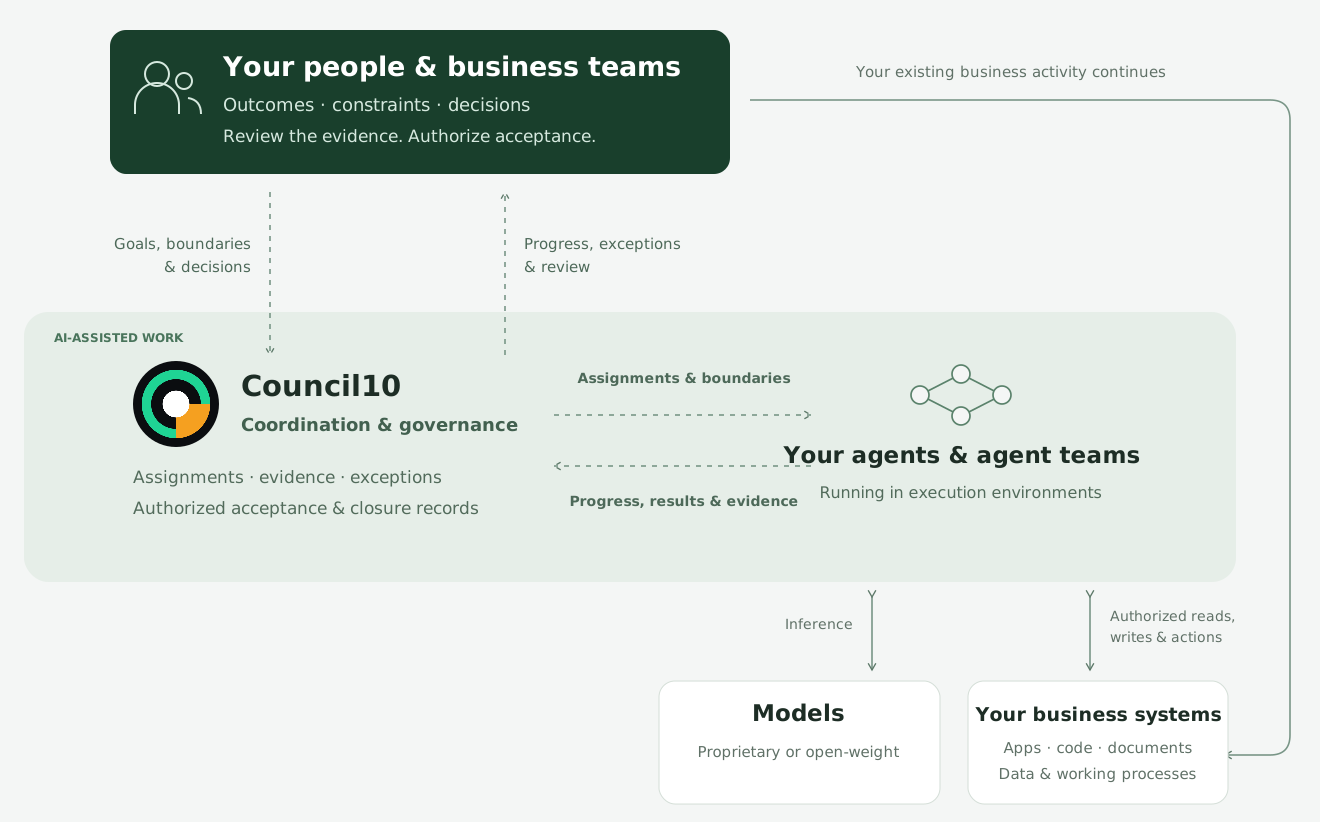
Set outcomes and boundaries. Make the calls that are yours. Review the proof and sign off.
↓ Goals & decisions · ↑ Progress & review

Our principles: clear assignments, evidence, visible exceptions, and recorded acceptance decisions.
↓ Assignments & boundaries
↑ Progress, results & evidence
Carry out work in their execution environments.
Inference requests and responses.
Authorized reads, writes, and actions.
Your people continue to work directly with your business systems, too.
In your environment
Governance belongs alongside the agents doing the work. Keep model connections and business-system permissions explicit, and check authority where an action takes effect.
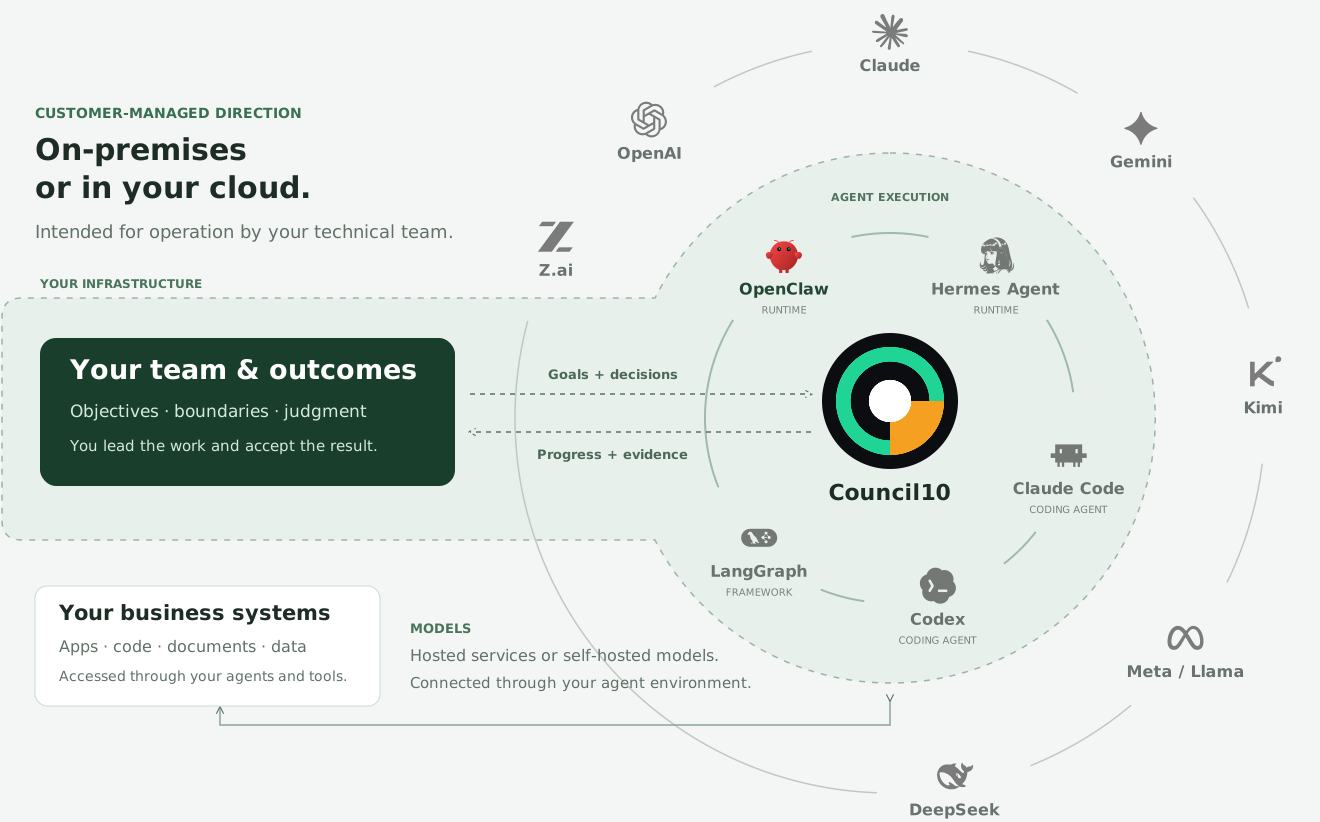
Your infrastructure · on-premises or your cloud
Teams should control their own environment.
Alongside connected agent execution
 OpenClaw
 Hermes Agent
 Claude Code
 Codex
 LangGraph
Hosted services or self-hosted models, accessed through agent execution.
 OpenAI
 Claude
 Gemini
 Kimi
 Meta / Llama
 DeepSeek
 Z.ai
Applications, code, documents, and data remain connected through your agents and authorized tools.
Color: internal use with Council10. Gray: wider ecosystem.
The agent ecosystem spans execution environments, models and business systems. Teams should choose the combination that fits their work.
Work needs a durable, shared record: the assignment, the evidence, the decisions, the acceptance and the next step.
Models generate and reason. Agents act. Progress needs authority, evidence and acceptance.
Writing down a rule is not enough to govern an action. For a consequential action to be governed, the system that can carry it out must check and enforce the required permission before the action takes effect. Checking afterward is a different control: it cannot undo an external action.
This does not mean all activity must pass through one central gateway. Any claim about enforcement must say which actions and paths it covers. Actions and paths outside that coverage must not be described as governed.
An agent saying it finished is a claim to check, not enough proof to accept the result. Check evidence against the agreed criteria: inspect or test the work itself, observe the result in the system where the action took effect, or do both, as appropriate.
The evidence must show more than the worker's own account. A second reviewer repeating that account is not independent verification. Record what was observed, where it came from, which work and attempt it concerns, and what it does and does not establish. Keep the authorized acceptor's decision traceable to those checks and the exact evidence reviewed.
If the worker can also change the evidence or the record used to check it, address or disclose that limit on independence. A hash alone does not solve it. Leave missing evidence or evidence that cannot be verified as an explicit gap; do not call it success.
How you run it
We’re building Council10 customer-managed first, in your own environment.
Your team should control its environment, access and connections. Business owners should retain objectives, important decisions, and sign-off.
External models and services still follow your chosen connections and data policies.